Stick Figure Family Friends Silhouette Graphics & Illustrations
Evaluating Hand-Drawn Warmth for a Community Brand Identity
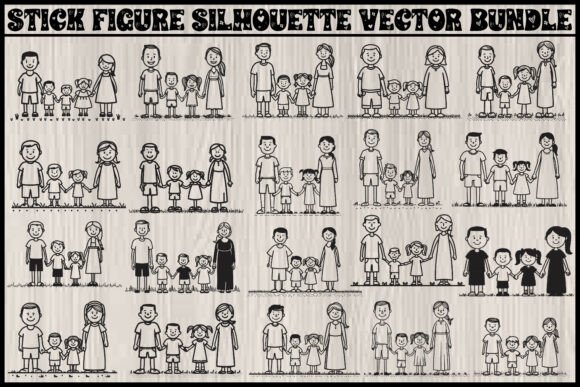
When sourcing a graphic design asset for a client project centered on community, nostalgia, or family-oriented services, the balance between professional polish and authentic charm is critical. I recently evaluated the Stick Figure Family Friends Silhouette vector bundle for a local parenting cooperative rebranding their visual identity. The immediate impression was one of unpretentious warmth. Unlike rigid, geometric iconography often found in corporate stock libraries, these illustrations possess an organic, hand-drawn quality that instantly lowers the barrier between brand and audience. For designers tasked with translating abstract concepts like "togetherness" or "friendship" into tangible marketing visuals, this collection offers a distinct emotional anchor that feels human rather than manufactured.
The aesthetic sits comfortably at the intersection of modern minimalism and folk art. It avoids the sterile look of standard clipart while remaining clean enough for versatile application. In my assessment, this style is particularly effective for clients in the education, childcare, handmade goods, and local event sectors. The silhouettes communicate universal themes without specific demographic markers, making them inclusive and adaptable. However, as with any specialized design bundle, understanding its practical limitations is just as important as recognizing its strengths before integrating it into a commercial workflow.
Performance Across Print-on-Demand and Digital Merchandise
In real-world application, the versatility of this Silhouette Vector Bundle shines brightest in merchandise and physical product design. During the mockup phase for our client’s welcome kits, we utilized these assets for t-shirt design and canvas tote bags. Because the designs are true vectors, they scaled from a small chest logo to a large back print without losing edge integrity or developing pixelation. This scalability is non-negotiable for print-on-demand sellers and Cricut users who need a single master file to serve multiple production methods.
For sublimation design and sticker creation, the solid silhouette format proved advantageous. Complex gradients or thin lines often fail during the heat press or vinyl cutting process, but these bold shapes transferred cleanly onto ceramic mugs and adhesive vinyl. We also tested the assets within Canva templates for social media promotion. The simplicity of the stick figure forms allowed them to act as supporting decorative elements rather than competing with headline text. When creating Instagram carousels or Pinterest pins, the graphics provided necessary visual breathing room, guiding the viewer’s eye through the content hierarchy without adding cognitive load.
Strategic Placement in Packaging and Editorial Layouts
While these graphics excel in merchandise, their role in packaging design and editorial design requires more strategic consideration. For a boutique candle line extension, we used the family silhouettes as secondary patterns on box sleeves and tissue paper. Here, they functioned as texture and mood-setters rather than primary focal points. This approach works exceptionally well for small business branding where the goal is to evoke a feeling of home and safety. The repetitive use of these friendly figures created a cohesive unboxing experience that reinforced the brand narrative of connection.
In digital contexts like web design and blog headers, the asset serves as an excellent emotional bridge. For an "About Us" page or a community guidelines section, placing a relevant silhouette next to copy can soften the tone of instructional text. However, designers must be mindful of scale. These illustrations carry significant visual weight due to their solid fill. Using them too large in a confined digital space can make a layout feel top-heavy or juvenile. They perform best when given ample negative space, allowing the "joy of togetherness" theme to resonate without cluttering the user interface.
Navigating Visual Hierarchy and Brand Consistency
A critical aspect of reviewing any creative design asset is determining where it does not belong. The Stick Figure Family Friends Silhouette collection is inherently informal. While perfect for a daycare, family reunion, or artisan market, it would likely undermine the authority required for financial services, legal consulting, or high-tech B2B marketing. Designers must ensure the whimsical nature of these illustrations aligns with the client’s established voice. Introducing such a playful element into a serious brand identity can create dissonance that erodes visual trust.
Furthermore, readability can suffer if these silhouettes are placed against busy photographic backgrounds or complex textures. Because they rely on shape recognition, low contrast is the enemy. During testing, white silhouettes on cream backgrounds disappeared entirely in print proofs. To maintain strong visual hierarchy, always pair these assets with high-contrast backdrops or use them as masks for photography. Additionally, avoid using them at extremely small sizes (below 0.5 inches) where the distinct limb details merge into indistinct blobs. In those instances, a simpler abstract icon may be superior for maintaining professional clarity.
Technical Pre-Flight Checklist for Commercial Application
Before committing this digital product to a final deliverable, professional designers should run through a rigorous technical validation process. This ensures the asset performs reliably across all intended media and protects both the designer and client from licensing issues.
- Vector Integrity Check: Open the SVG files in Illustrator or Affinity Designer to confirm paths are closed and editable. Ensure there are no stray anchor points that could cause cutting errors in Cricut projects.
- Contrast Testing: Preview the PNG designs in grayscale to verify they remain legible without color reliance. Test on both pure white and dark charcoal backgrounds to assess versatility.
- Typography Pairing: Experiment with various typefaces. These silhouettes pair beautifully with rounded sans-serifs and organic handwritten scripts but may clash with sharp, high-contrast serif fonts typically used in luxury branding.
- Print Proofing: Never skip a physical test print for merchandise. Screen brightness often deceives; verify that fine details in the stick figures hold up at actual size on paper or fabric.
- Licensing Verification: Scrutinize the commercial license terms specifically. Confirm whether the asset allows for resale in digital templates versus physical end-products, as restrictions vary significantly between creative marketplace vendors.
- File Format Audit: Ensure the bundle includes transparent PNGs for web overlay and scalable SVGs for print. Raster-only bundles limit professional utility for large-format signage or packaging.
Final Verdict for Creative Professionals
The Stick Figure Family Friends Silhouette bundle represents a valuable tool for designers focusing on the human-centric segment of the market. Its strength lies in its ability to convey complex emotional narratives—friendship, family, happiness—through simple, universally understood visual language. For Etsy product creators, bloggers, and small business owners, it offers a shortcut to achieving a polished yet personal aesthetic that resonates deeply with target audiences.
However, successful implementation depends entirely on context. As a commercial design asset, it demands thoughtful placement and strict adherence to contrast and hierarchy principles. It is not a universal solution, but for the right project, it transforms generic layouts into meaningful visual stories. By treating these illustrations with the same technical rigor as any other professional design element, creatives can leverage their inherent warmth to build brands that feel genuinely connected to the people they serve. When used with intention, this collection proves that even the simplest graphic forms can carry profound communicative power in modern visual culture.